ATMOS 2024 Report
Summary and recommendations from the workshop held in July 2024 in Bologna, Italy.
The ECAMS (EarthCARE ATLID and MSI Instruments Synergy for Advanced Retrieval of Aerosol Vertical Profiles) project focuses on enhancing aerosol vertical profiling through the integration of active and passive satellite measurements. By combining data from EarthCARE’s ATLID (Atmospheric LIDar) and MSI (Multi-Spectral Imager) with PACE mission’s polarimeters (SPEXone and HARP-2), ECAMS aims to develop a …
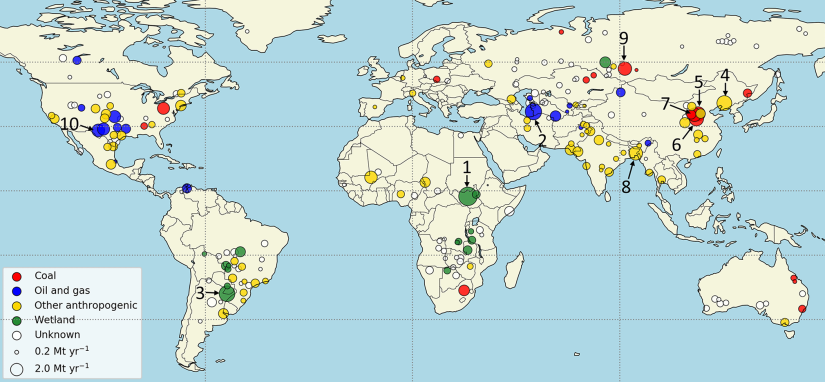
The anthropogenic emissions of methane (CH4), after those of carbon dioxide (CO2), are the second most important man-made source of greenhouse gases contributing to global warming. Over a 20-year timescale, each kilogram of methane emitted has a global warming potential more than 80 times more potent than carbon dioxide. Reducing methane emissions would help to …
The Arctic is warming more than twice as fast as the global average, making climate change’s polar effects more intense than anywhere else in the world. The Arctic accounts for half of the organic carbon stored in soils. There is high confidence that the thaw of terrestrial permafrost will lead to carbon release, but only …
EO4SEM aims to advance towards the EO-driven monitoring of ship emissions, particularly GHGs such as CO2 and CH4 as well as air pollutants like NOx. The motivation comes from the need to improve our understanding of these emissions from ships and in view of new and future regulations within the European Union (EU) and at …
Regions with intensive agriculture often suffer from air pollution and acidification/nitrification of the soil. In addition, these regions are often responsible for the release of methane emissions. Methane (CH4), the second most important greenhouse gas (GHG) after carbon dioxide (CO2), is emitted from cattle farms, rice paddies and the use of manure. Excessive anthropogenic emissions …
DECSO-NRT-Europe aims to develop a near-real time (NRT) NOx emission service for Europe based on Sentinel data. NRT means emissions estimates are derived less than one month after the actual emission. In the first phase, we plan to build the NRT service for Sentinel-5P data, using the existing state-of-the-art inversion algorithm DECSO. In the second …
Background Imaging spectroscopy in the visible to shortwave infrared wavelength range, is a powerful tool for the remote sensing of Earth surface and atmosphere properties. Imaging spectroscopy measurements have a high diagnostic power: spectroscopic observations with hundreds of contiguous spectral channels provide detection sensitivity to a wide range of physical processes and materials. The technique …
The OneSun project (a physics-constrained,self calibrating,data-driving system with a common solar spectrum for homogeneous trace gas retrieval network) introduces an innovative approach to trace gas retrievals, addressing critical challenges in the operation of fiducial reference networks for satellite validation: ensuring homogeneity in calibration, maintaining high data quality, and enabling scalable network operations. Central to this …
Daniel is a postdoctoral research associate working at the University of Leicester, and part of the UK National Centre for Earth Observation (NCEO). For the past three years, he has worked at Space Park Leicester, where he helped set up the SPENSER laboratory for the study of atmospheric gases through infrared spectroscopy. He has experience …