

Understanding how Earth’s upper atmosphere is changing is essential for reliable climate assessment. Yet for decades, scientists have lacked a consistent, long-term record of ozone and temperature in the mesosphere, the atmospheric region between roughly 50 and 100 km altitude. This layer plays a key role in atmospheric chemistry, solar interaction, and vertical coupling with lower atmospheric regions, yet observational coverage has remained fragmented.
The METEOR (MEsospheric TEmperature and Ozone climate data Record) project has now filled this gap by creating the first comprehensive merged climate data records of mesospheric ozone and temperature spanning more than 30 years.
Combining three decades of satellite observations
METEOR integrates measurements from six satellite instruments operating between 1991 and 2023: ACE-FTS, GOMOS, MIPAS, MLS, HALOE and SOFIE. For temperature, three additional datasets are included (OSIRIS, OMPS-LP/SNPP and GOMOS-HRTP) and the vertical coverage extends to the whole middle atmosphere.
Each dataset was carefully pre-processed, intercompared and harmonized.
Monthly zonal mean profiles and de-seasonalised anomalies were calculated in local time. A dedicated merging methodology, adapted from the ESA Ozone_cci framework and extended to address mesospheric diurnal variability, was then applied.
Final merged anomalies were derived as the median across individual datasets, providing a robust estimate that minimizes the influence of outliers and instrument-specific biases.
The resulting METEOR-O₃ and METEOR-T datasets include daytime and nighttime profiles with associated uncertainty estimates. Ozone uncertainties are typically below 2%, increasing to 5–10% near the mesopause. Temperature uncertainties are generally below 0.5 K, rising to about 1 K at higher altitudes.
Clear signals in ozone and temperature trends
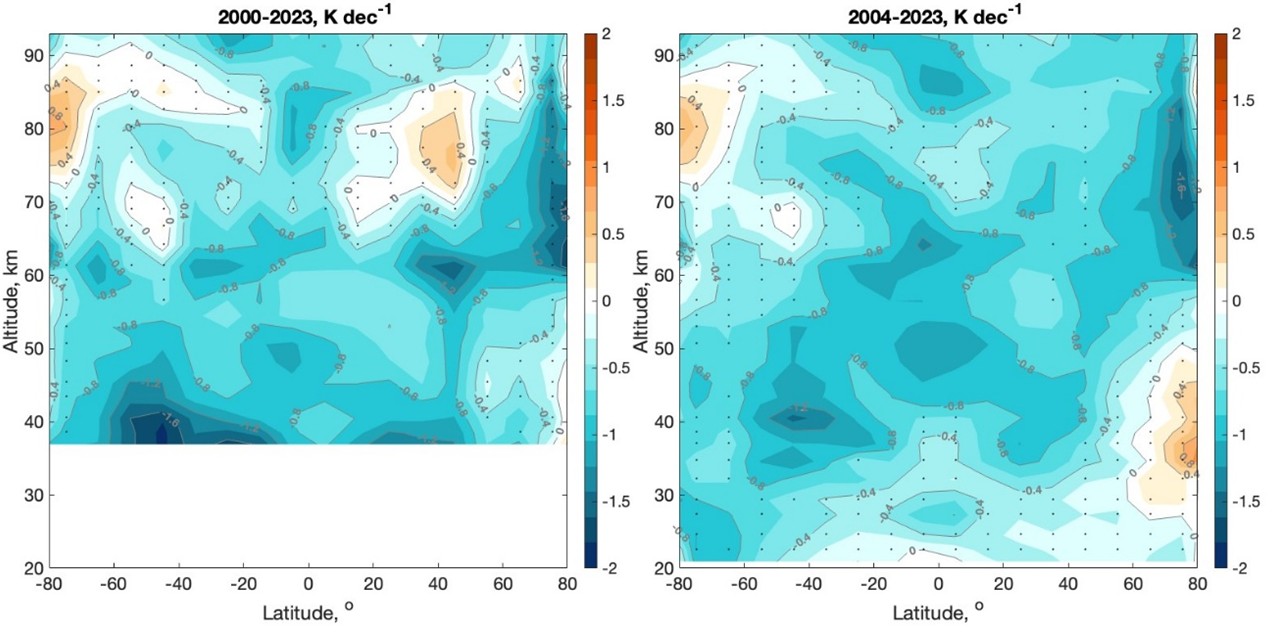
Using the merged records, the team conducted global and seasonal trend analyses for 2000–2023 and 2004-2023. A multiple linear regression framework accounted for dynamical and solar influences, including QBO, ENSO and solar variability.
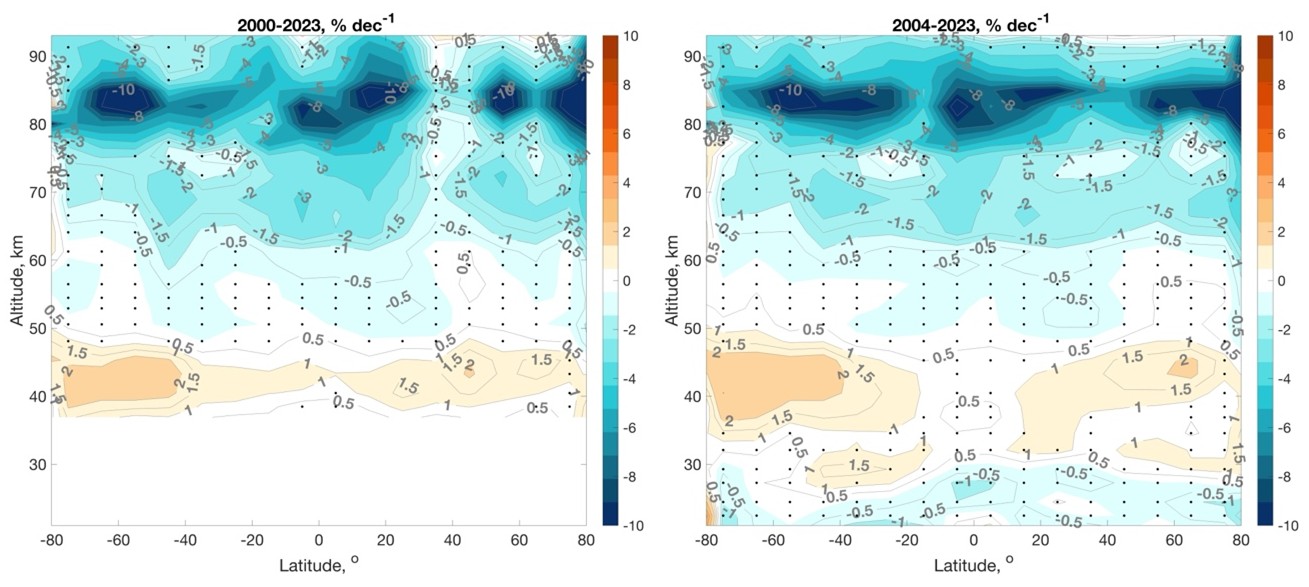
The results show a nuanced vertical structure. In the upper stratosphere, ozone exhibits recovery of about 1–2% per decade, consistent with established assessments. In contrast, the mesosphere shows persistent declines: roughly 1–3% per decade between 60 and 80 km, intensifying to 8–12% per decade between 80 and 90 km. Temperature trends are predominantly negative, typically ranging from −0.5 to −2 K per decade. Including geomagnetic activity in the analysis produces only minor adjustments, underscoring the robustness of the findings.
A foundation for future climate monitoring
The merged datasets are openly available and provide a long-needed foundation for systematic mesospheric climate monitoring:
By closing a major observational gap, METEOR strengthens our ability to assess long-term upper-atmospheric change and to validate high-top climate models.
The project team recommends establishing regular operational updates and integrating the datasets into long-term climate service frameworks to ensure sustained monitoring of this critical atmospheric region.