

On 22 January 2026, the Italian Italian Embassy in Prague organised with ESA a special educational session introducing Czech students to Earth Observation (EO) from space, with lectures delivered by experts from ESA’s ESRIN centre in Frascati, Italy.
The interactive event, hosted by the Italian Cultural Institute in Prague, gathered students and teachers from the Czech capital’s Gymnasium Ustavni. The session was led by Francesco Sarti, Connor Heeney, and Massimiliano Ferrante from ESA, who guided participants through the fundamental principles of remote sensing and the role of ESA satellites in monitoring our changing planet.
“Engaging young people in understanding how satellites observe the Earth is key to building new generations that are more aware of the impacts of climate change and the threats facing our environment and ecosystems,” noted Francesco Sarti during the introduction. “It is particularly rewarding to do so in the vibrant academic setting of Prague, through the active collaboration between ESA and Italian diplomatic institutions.”
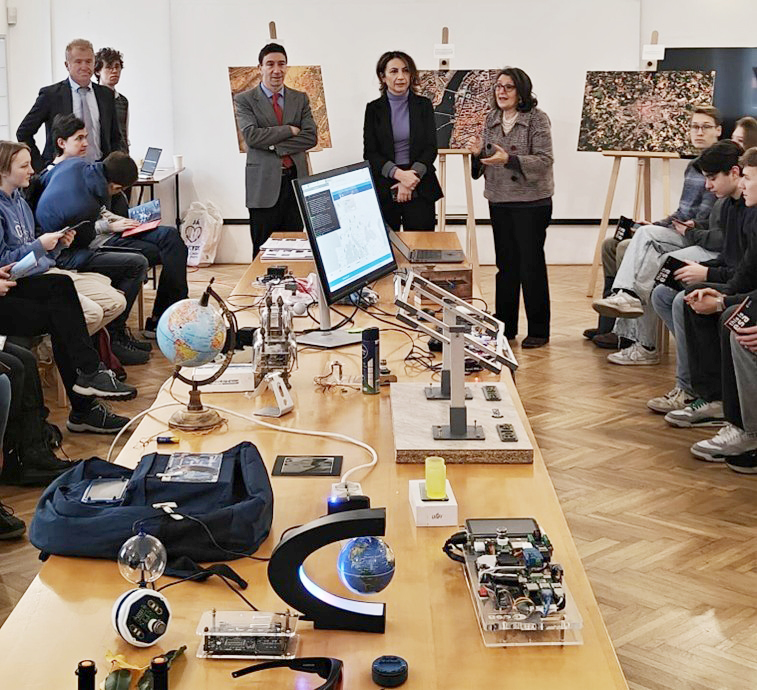
Over the course of the morning, students explored topics such as how satellites capture information across the electromagnetic spectrum, the relevance of ESA data for Central Europe, the Czech Republic, and the wider world, and how EO supports environmental management and urban planning.
Hands-on activities, inspired by those offered to schools at the recent ESA Living Planet Symposium 2026 in Vienna, included physical experiments as well as new free ESA web-based tools developed for educational use.
A live demonstration of ESA’s physical experiments related to remote sensing principles was particularly appreciated by the students and was followed by a lively Q&A session, highlighting their enthusiasm and curiosity about Europe’s space activities.
Using the ESA School Atlas, a free online educational tool, students performed simple analyses using real satellite imagery. Together with the presenters, they discussed exercises suitable for classroom or field use, and learned that those interested in continuing their projects could take part in the next edition of ESA’s Climate Detectives initiative.
The event was warmly received by teachers and students alike and was also covered by ANSA and several Czech media outlets. Maria Cristina Falvella, Space Attaché to the Italian Embassy in Prague, expressed gratitude for ESA’s contribution, emphasising the strong cultural and educational link fostered between Italy and the Czech Republic through science and space education.
By bringing space science closer to schools, initiatives like this contribute to ESA’s mission of promoting space literacy and encouraging the next generation to engage with Europe’s cutting-edge EO programmes, and to get enrolled in relevant university studies.