
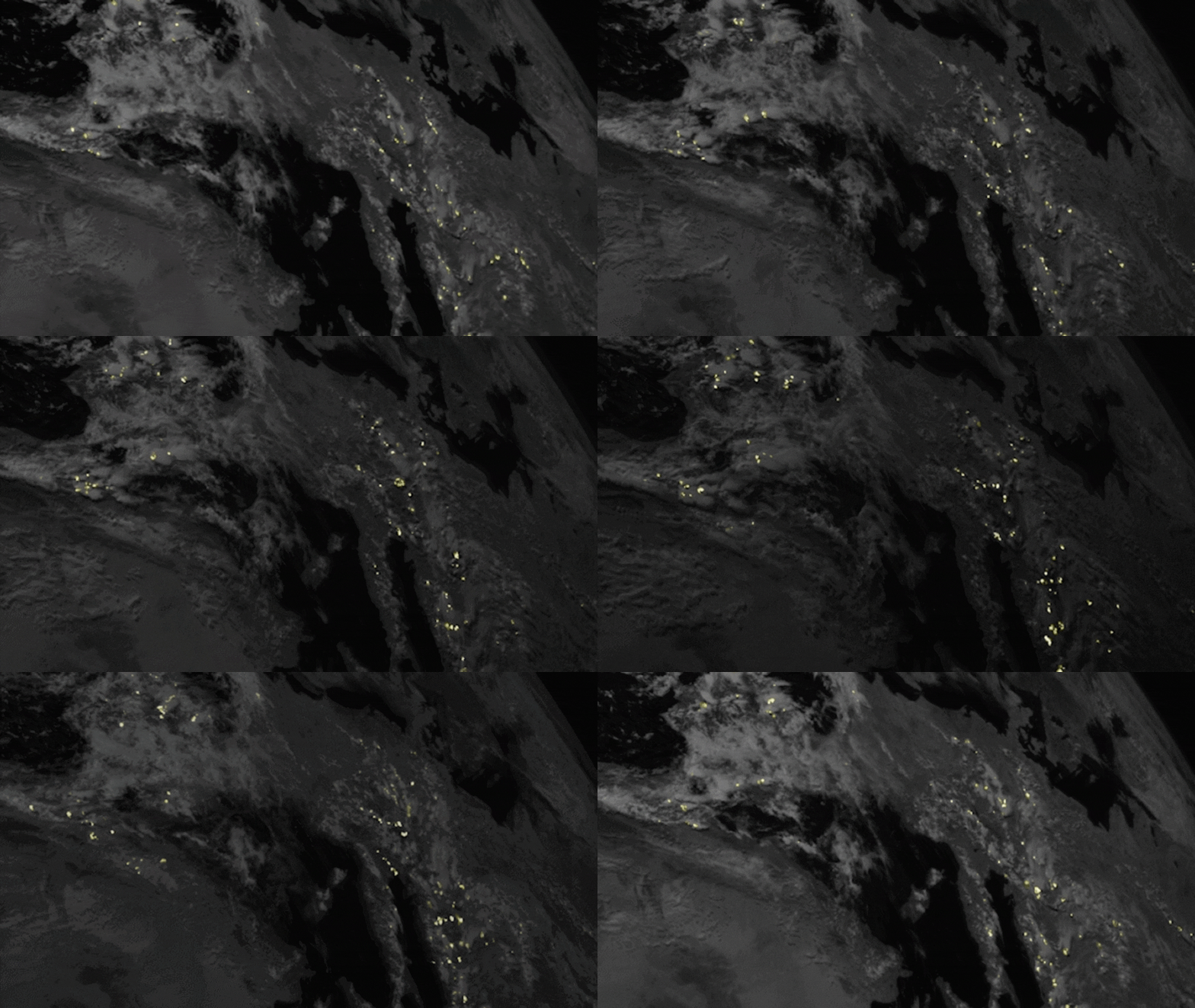
Last November 21 the European Severe Storms Laboratory (ESSL) has announced that Blanka Piskala, research fellow at the ESA Science Hub, is the recipient of the Heino Tooming Award 2025. The honour was presented at this year’s European Conference on Severe Storms (ECSS2025), recognising her team’s innovative work on understanding lightning and convective storms through a new multi-satellite perspective.
ESSL is Europe’s leading research institution dedicated to severe convective storms and extreme weather. Known for maintaining the European Severe Weather Database and advancing knowledge on tornadoes, hailstorms, and intense convective systems, ESSL also recognises scientists through the Heino Tooming Award.
Created in memory of Estonian meteorologist Heino Tooming, the award highlights not only scientific excellence but also the spirit of European cooperation: the prize is reserved for outstanding presentations delivered by research groups spanning at least two European countries. Blanka Piskala’s work, carried out with collaborators from Italy, Czech Republic and the Netherlands, embodies this cross-border ethos.

A perfect match with ESA Science Hub
Blanka is currently conducting her research at the ESA Science Hub, a centre of excellence that brings together Earth system scientists to harness the full scientific potential of ESA’s Earth-observation missions. The Hub’s mandate is to accelerate climate and atmospheric research through advanced satellite data, high-resolution modelling, and interdisciplinary collaboration.
Her award-winning work exemplifies this mission, and demonstrates how ESA’s satellite missions, designed to study Earth’s radiation budget, cloud microphysics and atmospheric processes, can directly support Europe’s understanding of severe weather hazards.
The research: a new satellite perspective on electrified convection
The study presented at ECSS2025 explored convective storms using a unique synergy between EarthCARE, launched in 2024, and two new-generation geostationary lightning sensors: the Meteosat Third Generation Lightning Imager (MTG-LI) and the Geostationary Lightning Mapper aboard the GOES-R series (GOES-GLM).
EarthCARE provides detailed vertical profiles of clouds, aerosols and precipitation using a combination of radar, lidar and multi-spectral imaging. Geostationary lightning sensors, on the other hand, continuously monitor lightning activity across Europe, Africa, the Americas, and the adjacent oceanic regions with remarkable temporal precision.
Blanka and the rest of the team combined these instruments to create a new catalogue of storm events where EarthCARE overpasses intersected with storms actively producing lightning detected by geostationary lightning sensors. This approach allows the team to explore the connection of the internal structure and dynamics of storms with the evolution of lightning within them.
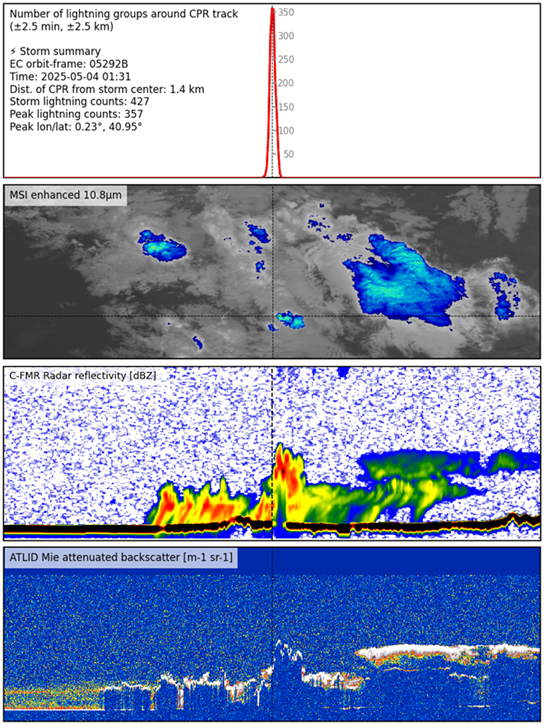
This is one of the first demonstrations of how an active profiling mission and a geostationary lightning observations can be combined to study the storm electrification. It marks a significant step forward for future research on aerosol–cloud interactions, convection and changes in severe storms.
More details on Blanka’s research activity can be explored on her ESA Science Hub dedicated project page on Combined EarthCARE–Geostationary lightning observations of convective storms.
Why this matters
In an era of increasingly frequent and intense severe-weather events, the ability to observe and understand convective storms is more important than ever. This work showcases how next-generati on satellite missions can illuminate the internal processes of thunderstorms that ground-based networks often miss.
This highlights the strategic value of ESA missions such as EarthCARE and MTG, whose combined datasets can transform how researchers study extreme weather.
Receiving the Heino Tooming Award is a significant milestone which acknowledges exceptional scientific achievement while emphasising the importance of cross-European cooperation, something that lies at the heart of both ESSL’s mission and ESA’s scientific programmes.
Featured image : MTG Lighning Imager animation over Europe. Credit: EUMETSAT/ESA