

Since 2021, the European Space Agency (ESA) and the African Union Commission (AUC) have collaborated on the African Research Fellowship (ARF) program. This initiative is designed to empower emerging African researchers (Postdoc, PhD and master’s degree holders) with significant research experience in Earth Observation (EO). Fellows are challenged to develop innovative and reliable solutions for the African continent, with a particular focus on key areas like water resource management and food security.
The program expects fellows to maximize use of EO data, integrating it with in-situ data and modeling techniques within a cloud-based environment. To facilitate this, fellows conduct their research at ESA-ESRIN, where they have access to the EO AFRICA Innovation Lab, a cutting-edge cloud platform that provides essential data, tools, and hosts open-source algorithms. They also benefit from the expertise of ESA staff and gain access to the EO AFRICA Space Academy and its Digital Campus. To date, ten fellows have completed the program, with the latest group of four— Mohamed Rajhi, Amandine Carine Njeugeut Mbiafeu, Moreblessing Muzava, and Mohamed Rammadan—currently carrying out their one-year research activities in ESA-ESRIN.
The photo above features the current African Research Fellows: Moreblessing Muzava, Amandine Carine Njeugeut Mbiafeu, Mohamed Rammadan and Mohamed Rajhi, alongside with Inge Jonckheere, head of Green Solutions Division, Giuseppe Ottavianelli, head of the Applications Section, Benjamin Koetz head of the Sustainable Initiatives Office. Also pictured the ESA EO AFRICA Team (Zoltan Szantoi, Anke Schickling and Francesco Palazzo).
Dr. Mohamed Rajhi, researcher and project manager at the Tunisian Space Association (TUNSA), is conducting research on the water footprint (WF) of cereal production in Tunisia, a critical issue for agricultural sustainability in arid and semi-arid regions. His fellowship research integrates multi-source Earth Observation (EO) data, climate reanalysis, and artificial intelligence to quantify green water (rainfall) and blue water (irrigation) use from 2019 to 2024. The study aims to produce high-resolution spatial assessments of cereal water footprints, delivering decision-ready insights to optimize irrigation efficiency, promote sustainable farming practices, and support evidence-based water policy in water-scarce environments.
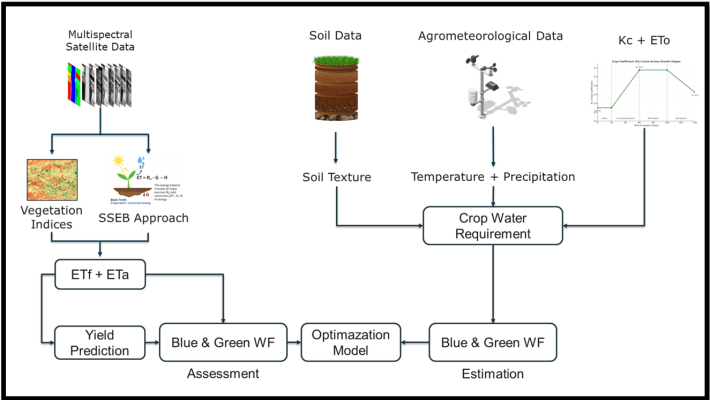
Overview of the planned research.
Dr. Amandine Carine Njeugeut Mbiafeu is a Cameroonian researcher at CURAT (Centre Universitaire de Recherche et d’Applications en Télédétection) in Côte d’Ivoire with a PhD in Remote Sensing and GIS, specialized in Climate, Environment, and Sustainable Development. As a consultant and lecturer, she focuses on natural risk management and land cover change monitoring. Within ARF, her project focuses on monitoring the Cocoa Swollen Shoot Viral Disease (CSSVD) in Côte d’Ivoire, with a particular focus on the Soubre region, the most affected area. Her work applies hyperspectral and multispectral imagery together with deep learning models to design early warning approaches, analyze the disease’s spatial dynamics, and evaluate its impact on cocoa production and food security.
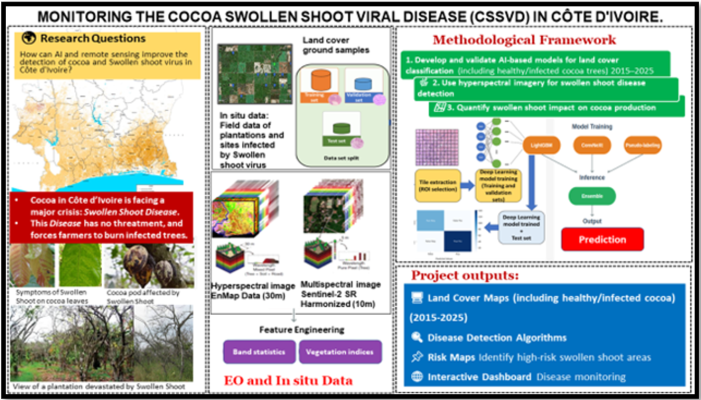
Overview of the planned research.
Ms. Moreblessing Muzava, a Zimbabwean researcher holding a M.Sc. degree in Integrated Water Resources Management from the University of Zimbabwe, is using Machine Learning and Earth observation data to help smallholder farmers in her country to enhance responsible water management and resilience to climate change. Her work aims to enhance flood and drought risk assessments by calibrating high-resolution land surface models (50–200 m) for two pilot catchments, leveraging on multi-year satellite imagery, hydro-meteorological, and land cover datasets. The expected outcome of her research is the production of predictive tools to map flood inundation extents and depths across different return periods, supporting disaster preparedness and sustainable water management. Her research aligns with her passion for applying Earth observation and data-driven approaches to tackle water security and climate challenges in Southern Africa.
Time-series of high-resolution fractional vegetation cover (FCOVER) for the High-Resolution Land Data Assimilation System (HRLDAS), covering January 2014 to December 2021 over the Save and Runde catchments in Zimbabwe. The dataset captures the temporal dynamics of vegetation density at fine spatial scales.
Dr. Mohamed Rammadan, is an Egyptian Assistant Professor at the Geology Department of the Faculty of Science, Port Said University, Egypt. He got his MSc and PhD in water resources from Port Said University, Egypt, specializing in coastal areas. He had a postdoctoral position at EDYTEM, Université Savoie Mont Blanc, France. His ESA-ESRIN fellowship presently focuses on assessing Coastal Processes and Climate Change Impacts Using Earth Observation Satellite Data: A Case Study of Northern Coastal area of Egypt. His research aims to provide a thorough evaluation of the coastal dynamics along Egypt’s northern coastline and to aid the development of long-term policies for climate resilience and sustainable coastal management.
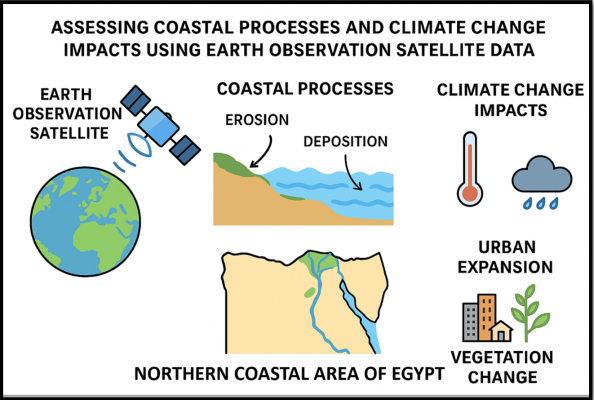
Overview of the planned research.
The ARF program is a key component of the larger Earth Observation for African Framework for Research, Innovation, Communities and Applications (EO AFRICA), run in cooperation between ESA and AUC. This comprehensive program is dedicated to advancing sustainable EO and space technology throughout Africa by fostering knowledge transfer, research, and application development that directly addresses the needs of African users. The EO AFRICA community is growing rapidly, with over 5,500 members, and has achieved several milestones, including:
- Supporting five African university teams in developing EO-based curricula.
- Making 12 different training packages on various EO topics freely available.
- Providing free training courses (Face to Face, Webinars, MOOCs, Hackathons).
- Launching more than 50 Tandem (shared African-European) research projects and over 10 R&D application projects.