
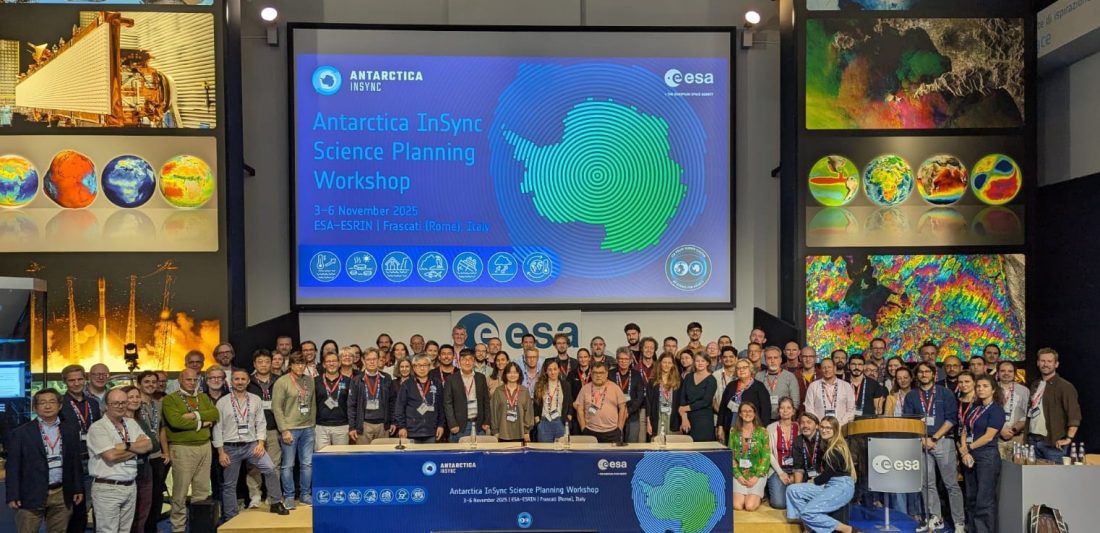
More than 100 participants from over 20 nations gathered at ESA’s ESRIN centre for the Antarctica InSync Science Planning Workshop, marking a major milestone in shaping the future of international Antarctic research.
The four-day event centred on discussions around the seven priority science themes and seven cross-cutting groups, each contributing to the ambitious coordination of research under the Antarctica InSync initiative. The science themes are:
- Southern Ocean and Antarctic heat, freshwater, carbon and other elements cycles and their response to climate change.
- Rapid sea-ice decline and its causes and consequences.
- Melting ice sheets and ice shelves, and coastal impacts.
- Improving knowledge and protection of the unique Antarctic life: from land to ocean and into the deep sea.
- Anthropogenic signatures in Antarctica: the race against pollution and other pressures.
- Aerosol-cloud interactions and radiative feedbacks.
- Climate variability: from extremes, to weather, long-term variability, and global teleconnections.
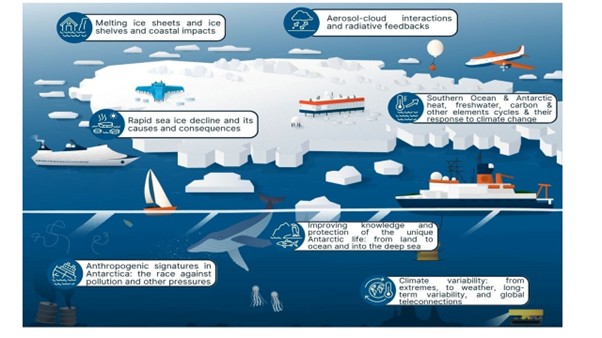
Each science theme is now preparing a whitepaper outlining key research priorities, gaps, and proposed activities to guide collaborative efforts in the years ahead.
Among the cross-cutting groups, the EO community drew strong participation, emphasizing the critical role of satellite and remote sensing data in advancing Antarctic science. Discussions highlighted the importance of:
- Integrating Earth Observation datasets, in-situ observations, and modelling frameworks to enhance understanding, simulation, and prediction of Antarctic system evolution.
- In-situ campaigns under Antarctica InSync to provide calibration and validation (cal/val) support for satellite missions, driving the development of new and improved EO products, particularly from new and upcoming ESA missions such as CRISTAL, ROSE-L, CIMR, Harmony, and BIOMASS.
- EO-driven research projects, which offer opportunities for pan-Antarctic coverage and continuity of observations beyond the formal Antarctica InSync period, helping sustain coordinated research efforts through to the next International Polar Year (IPY5).
By bringing together experts across disciplines and nations, the workshop reaffirmed a shared commitment to advancing understanding of the Antarctic system, one of the most critical components of Earth’s climate and environmental balance.
Draft versions of the whitepapers are schedule to be published at the end of December and will be open for public consultation and feedback during January 2026. The final versions of the whitepapers are scheduled to be published in February 2026.