

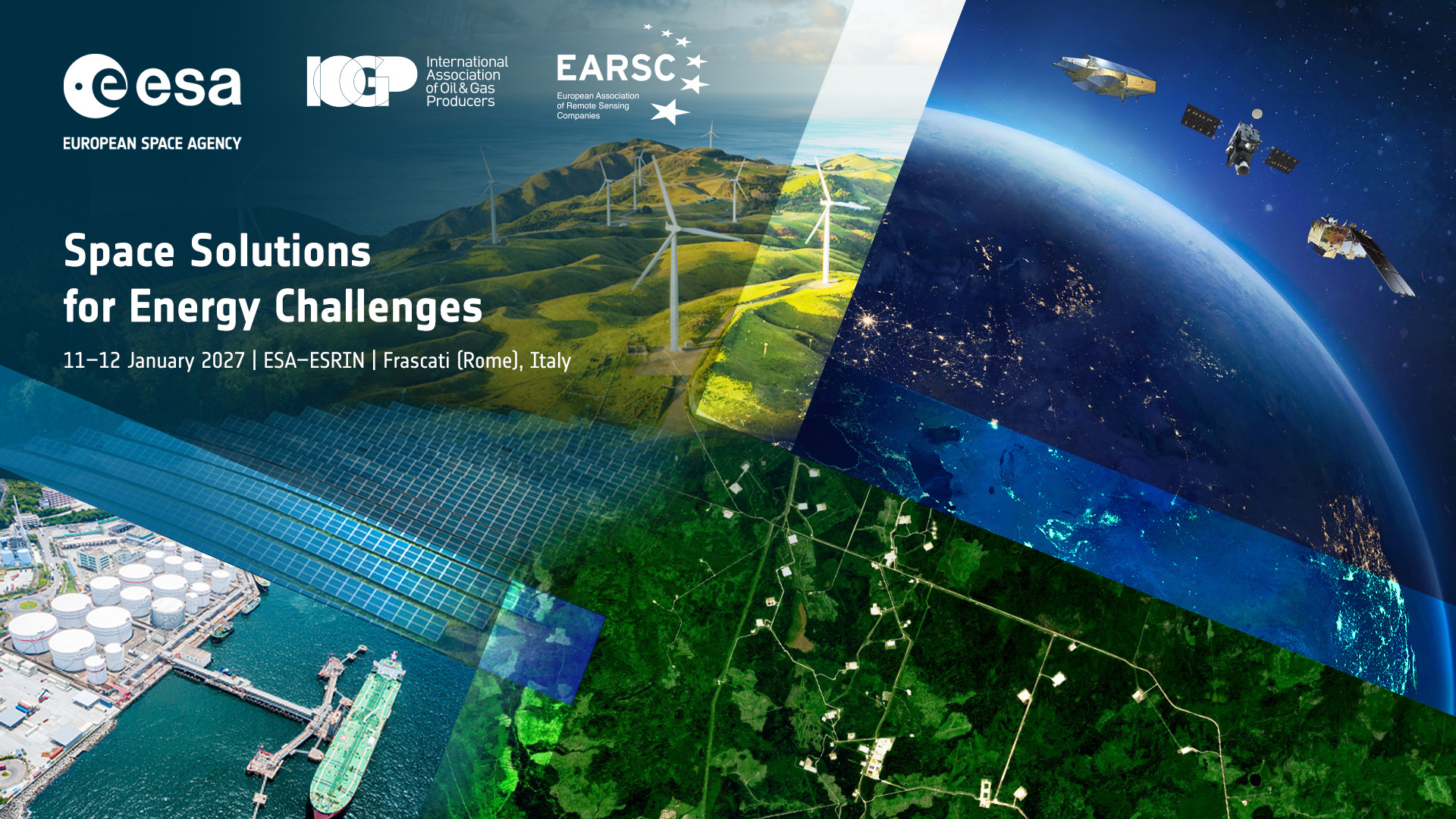
Space Solutions for Energy Challenges
January 11, 2027 - January 12, 2027
ESA-ESRIN
Welcome
As the global energy landscape continues to diversify, Earth Observation (EO) technologies are playing an increasingly important role across the energy value chain, supporting planning, development, operations and monitoring of energy projects, while contributing to operational excellence, resilience, security, and sustainability objectives. The relevance of EO applications now extends beyond traditional energy use-cases to renewable energy and other emerging components of the low-carbon energy economy.
Bringing together representatives from across the energy sector and the EO community, the workshop aims to foster cross-sector knowledge exchange, identify common operational needs and gaps, discuss best practices and break down barriers that may hinder collaboration and innovation.
We look forward to welcoming you to ESRIN.
Through presentations, demonstrations, networking and collaborative working sessions, participants will discuss common challenges and explore current and future use of satellite-derived information to inform operational and strategic decision-making across the evolving energy sector. A key focus will be on better understanding and addressing the gap between what satellite technologies deliver and the information energy stakeholders need to make well-informed operational and business decisions.
Starting from key operational decisions, challenges and needs, participants will explore and assess EO solutions available today and discuss the potential of emerging capabilities and planned innovations to address existing gaps and evolving needs in the energy sector. Participants will also discuss key factors shaping operational uptake, including technical capabilities, validation, complementarity of different techniques, integration into existing business processes and workflows, and cost-effectiveness.
ESA experts will participate throughout the workshop and explore effective ways for ESA programmes to support future engagement and advances in EO applications for the energy sector.
Topics
Key themes will span onshore, offshore and atmospheric applications, including:
- Methane detection and emissions monitoring
- Renewable energy planning and operations
- Infrastructure and asset integrity monitoring
- Environmental and biodiversity monitoring
- Offshore and maritime operations
- Risk management and emergency response
- ESG reporting and sustainability applications
- Emerging EO technologies, opportunities and commercial services, in particular supporting the energy transition.
Who should participate
The workshop is designed for professionals interested in the operational application of EO technologies across the evolving energy sector, including:
- Oil and Gas Industry Representatives
- Renewable Energy Sector Representatives
- Public Sector and Partner Organizations
- The EO community, including EO experts, service providers, researchers, and application developers.
Agenda
Day 1 will set the scene through invited talks and focused panel discussions with key actors from across the energy sector, exploring the sector’s evolving priorities, challenges and opportunities and where EO can deliver value.
| Start | End | Leading Entity | Description |
|---|---|---|---|
| 9:30 | 10:00 | EARSC/ESA | Registration & Welcome Coffee |
| 10:00 | 10:30 | ESA | Emerging EO Sensors & Applications |
| 10:30 | 12:00 | ESA | Visit of ESA Φ-Experience & Quantum Computer |
| 12:00 | 13:00 | Lunch at the ESRIN canteen | |
| 13:00 | 13:10 | Opening of the Workshop | |
| 13:00 | 13:10 | ESA | Introduction and Logistics |
| 13:10 | 13:55 | Organisation | Setting the Scene: High-level Perspectives from the Organizers |
| 13:10 | 13:25 | ESA | High-level opening by ESA |
| 13:25 | 13:40 | IOGP | Energy Industry Perspective |
| 13:40 | 13:55 | EARSC | EO Industry Perspective |
| 13:55 | 17:55 | The Energy Industry Outlook | |
| 13:55 | 14:10 | IEA | Overview of the Global Energy Landscape |
| 14:10 | 14:40 | Wind Europe and Solar Power Europe | Challenges and Opportunities for the Renewable Energy Industry |
| 14:40 | 15:25 | Industry representatives | Panel Discussion on EO for the Renewable Energy Industry |
| 15:25 | 15:55 | Coffee break | |
| 15:55 | 16:10 | IOGP | Challenges and Opportunities for the Oil & Gas Industry |
| 16:10 | 16:55 | Industry representatives | Panel Discussion on EO for the Oil & Gas Industry |
| 16:55 | 17:10 | ESA | Challenges and Opportunities for Carbon Management |
| 17:10 | 17:55 | Industry representatives | Panel Discussion on Carbon Management |
| 17:55 | 18:20 | Master of Ceremony | Closure of Day 1 |
| 18:20 | 20:15 | Cocktail, drinks & food |
Day 2 moves from challenges to solutions and action, bringing users and providers together to match priority needs with existing or emerging EO solutions, foster concrete collaborations and define pathways towards implementation.
| Start | End | Leading Entity | Description |
|---|---|---|---|
| 8:30 | 9:00 | EARSC/ESA | Registration & Welcome Coffee |
| 9:00 | 9:15 | Opening of Day 2 | |
| 9:00 | 9:15 | Master of Ceremony | Opening of Day 2 |
| 9:15 | 11:15 | 5 breakout rooms | Interactive Session 1 |
| 9:15 | 9:55 | Round 1/3 | Round 1: Solutions and Actions for Day 1 Challenges |
| 9:55 | 10:35 | Round 2/3 | Round 2: Solutions and Actions for Day 1 Challenges |
| 10:35 | 11:15 | Round 3/3 | Round 3: Solutions and Actions for Day 1 Challenges |
| 11:15 | 11:45 | Coffee break | |
| 11:45 | 13:05 | Magellan room | Interactive Session 2: Prioritisation and Action |
| 11:45 | 12:15 | Facilitators | Key Outcomes of Interactive Session 1 |
| 12:15 | 12:45 | Attendees | Prioritisation and Follow-up Actions |
| 12:45 | 13:05 | Master of Ceremony | Wrap-up and Next Steps |
| 13:05 | 13:20 | ESA | Closing |
| 13:20 | 14:20 | Lunch at the ESA canteen | |
| 14:20 | 17:20 | Networking and Collaborative Sessions |
Intended outcomes of the workshop
- Expand industry engagement and cross-sector collaboration
- Engage stakeholders across the energy sector, including organisations such as IOGP, IEA and IRENA.
- Enable cross-sector engagement within the energy ecosystem and with the EO community.
- Plan for future engagements, maintaining momentum from the workshop and driving future collaboration.
- Capture industry needs and emerging requirements
- Identify and prioritise current and emerging industry challenges, business needs and use cases across the energy sector, considering operational, regulatory, market and sustainability requirements.
- Assess existing EO capabilities and identify which solutions are ready for operational use, which require further development or validation, and where critical gaps remain.
- Identify opportunities and actions to accelerate adoption
- Identify barriers to the operational uptake of EO across the energy sector.
- Highlight enabling factors, best practices and success stories.
- Define practical actions to increase the integration of EO into existing business processes and decision-making workflows.
- Identify opportunities for joint action by energy actors, including energy companies, EO providers and ESA to address adoption barriers and accelerate the operational uptake of EO solutions.
- Promote a shared understanding and advocacy for accelerated adoption of EO technologies.
- Gather feedback on the IOGP Remote Sensing Guidelines
- Capture industry experiences and perspectives on the applicability of the guidelines.
- Identify strengths, gaps and areas requiring clarification.
- Collect examples of successful and challenging implementations.
- Define the shape and direction of future guidelines.
- Define recommendations for future action
For IOGP- Potential updates, extensions or revisions to the Remote Sensing Guidelines.
- Opportunities for additional guidance materials, training and industry engagement activities.
For ESA
- Feedback on areas where ESA programmes can continue supporting the energy sector.
- Identification of technology gaps, demonstration opportunities and research priorities.
For EARSC
- Insights into industry needs and market opportunities.
- Recommendations for capacity-building and opportunities to strengthen collaboration between EO service providers and energy-sector stakeholders.
- Consolidate workshop outcomes
- Summarise key findings, lessons learned, recommendations and priority actions.
- Define follow-up activities for ESA, IOGP, EARSC and participating stakeholders to support wider operational EO adoption across the energy sector.
- Produce and distribute a consolidated Workshop Outcomes Report.
About the ESA Visiting Industry Professionals (VIP) programme
Connecting industry challenges with Earth observation innovation
The ESA Visiting Industry Professionals (VIP) Programme is an initiative that brings together industry experts and Earth Observation specialists to accelerate the adoption of EO technologies, ensuring they address real-world challenges and deliver tangible value to end users.
Through workshops, collaborative sessions, demonstrations, and technical exchanges hosted at ESA’s ESRIN centre, the programme provides a platform for identifying industry requirements, exploring innovative EO capabilities, and fostering long-term partnerships.
The VIP Programme enables direct interaction between users and EO service providers, helping to:
- Identify operational needs and priorities
- Validate EO-enabled solutions
- Share best practices and lessons learned
- Build strategic partnerships
- Support the transition from innovation to operational use.
Organising Committee
ESA – EARSC – IOGP
Registration
Registration is now open. Please register HERE by 20 December 2026.
Logistics
Contacts
For information regarding the submissions, author instructions, scientific committee related inquiries please contact events.organisation@esa.int.
Should you need a VISA Invitation Letter, please contact events.organisation@esa.int.