Target Audience
This workshop is intended for researchers, governmental and non-governmental organizations, investigative teams, legal bodies, and international agencies that develop or use EO for environmental compliance assurance, and particularly enforcement activities.
These includes:
- Police forces, prosecutors, judges, and inspectors dealing with environmental compliance and enforcement;
- International organizations dealing with environmental compliance or crime and protection agencies;
- Scientists using EO, or others form of geospatial data, to research issues related to environmental crime;
- Legal scholars researching the use of geospatial intelligence or OSINT data in compliance assurance;
- International organizations and NGOs working on environmental crime;
- Representatives from industry, startups, research centers active in the thematic areas addressed by the workshop
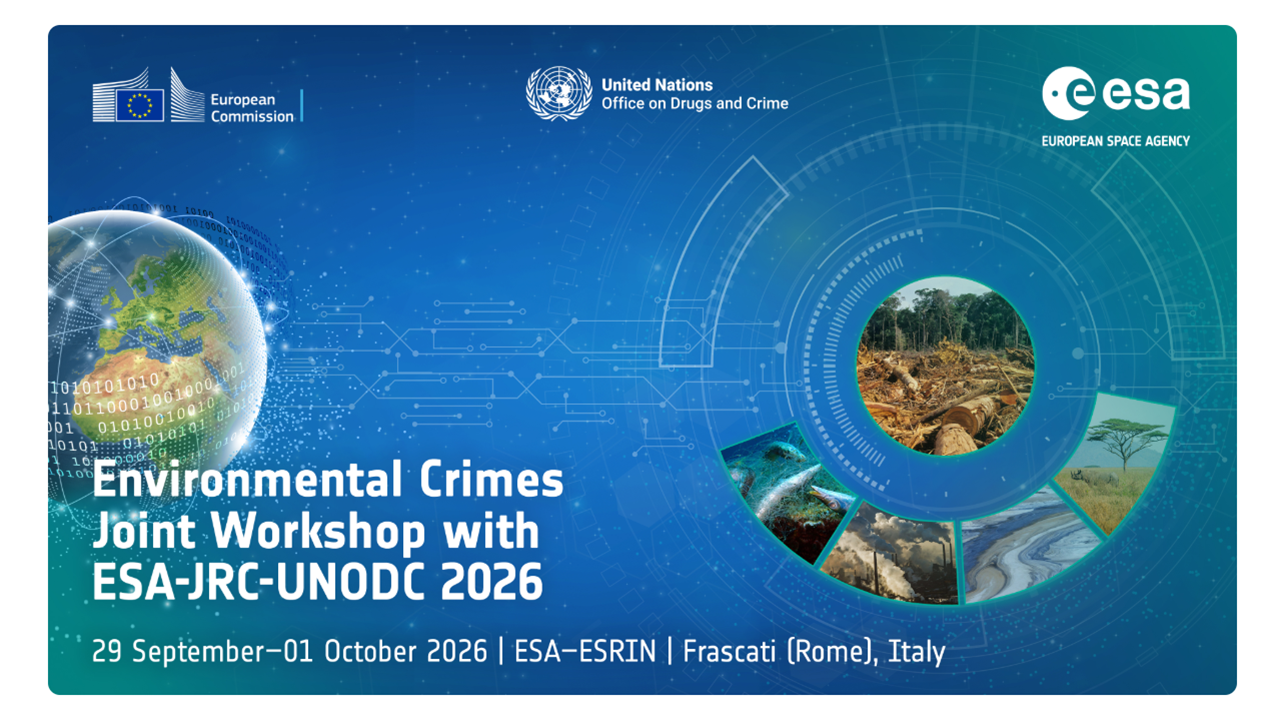
The workshop will be hosted at the ESA – ESRIN, Frascati (Italy), as an in-person meeting, with the possibility to follow the workshop remotely.
Topic areas:
The workshop will be structured around the main aspects of environmental compliance assurance : promotion, monitoring, enforcement, and capacity building.
Abstracts can be submitted indicating one of these four areas.
Promote
EO technology serves as a powerful tool for raising businesses’ and duty-holders’ awareness of their compliance with environmental regulations by offering insights into the impact of their operations on the environment. For instance, EO data can help assess greenhouse gas emissions, land usage, water pollution levels, resources exploitation. This EO-derived data facilitates informed decision-making to ensure business operations are environmentally compliant. Presentations on EO-driven ‘preventive’ measures should be submitted within this thematic area.
Monitor
Space technology can help assess and detect non-compliance with environmental regulations. Various types of sensors deployed in space offer extensive monitoring capabilities. For instance, spectrometers sensors can be used to measure atmospheric pollution, thermal infrared sensors to identify deforestation fires, optical sensors to detect wildlife poaching, and SAR sensors to track illegal fishing activities and oil spills, clear forest cuts, changes into mining sites among others. Such data can provide solid evidence and early alerts for enforcement in inspections, audits, investigations, and examination of public complaints. Presentations on EO and OSINT enabled ‘diagnostics’ should be submitted within this thematic area.
Enforce
Enforcement provides the means to of stopping non-compliance with environmental rules, applying sanctions, and repairing environmental damage. It covers, amongst other things, official warnings, cease-and-desist orders, administrative or criminal proceedings, application of sanctions, and demands to take remedial action. Presentations on EO and OSINT-backed ‘corrective’ measures should be submitted within this thematic area.
Capacity Building
Capacity building supports the effective uptake and operational use of EO and OSINT technologies for environmental compliance. It includes activities aimed at strengthening institutional, technical and analytical capacities among competent authorities, enforcement bodies, businesses and other relevant stakeholders. This may cover training, knowledge transfer, development of guidance, sharing of best practices, creation of user-friendly tools, and support to data interpretation and integration into existing compliance workflows. Presentations on EO- and OSINT-enabled approaches that enhance skills, cooperation and operational readiness for environmental compliance assurance should be submitted within this thematic area.
Thematic areas:
- Air pollution/ emissions
- Wildlife, Biodiversity and Protected Areas Crime
- Fisheries and marine environmental crime, including IUU Fishing and discharges
- Land Pollution, illegal waste and Hazardous Substances
- Illegal mining, quarrying and sand extraction
- Illegal water abstraction and water pollution
- Forestry crimes
- Illegal Fires and Burning
- Other
Schedule and Deadlines
| Abstract submission opening |
01 June 2026 |
| Abstract submission closing – EXTENDED |
29 July 2026 |
| Notification of acceptance |
03 August 2026 |
| Issue of Preliminary Programme |
04 August 2026 |
| Registration Opening |
04 August 2026 |
| Registration Closing |
01 September 2026 |
| Issue of Final Programme |
at the workshop |
| Workshop |
29 September to 01 October 2026 |