
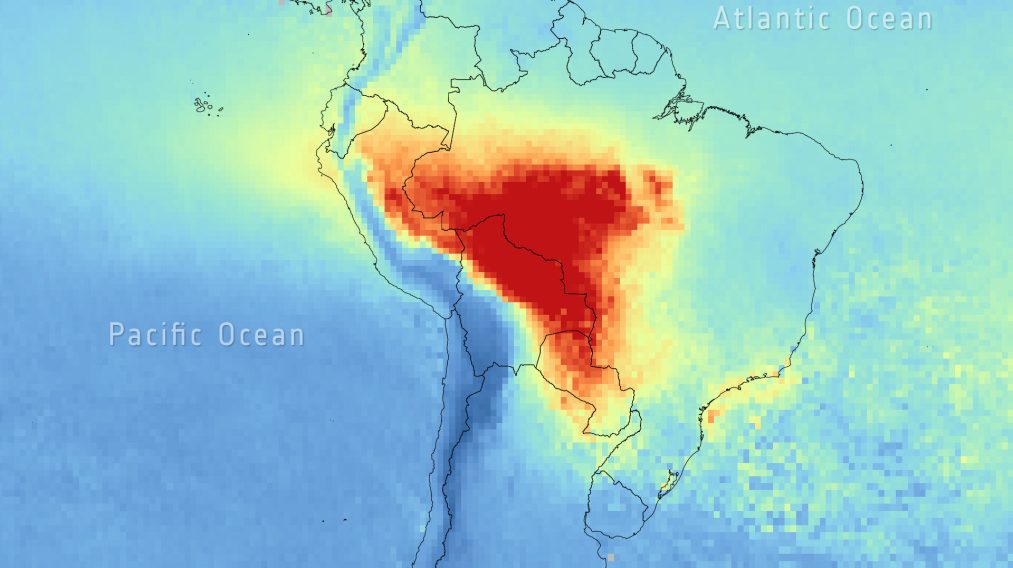
A recently published paper, outcome of the Sense4Fire project, highlights a significant gap in how we understand the climate impact of Amazon wildfires. Using combined observations from the Copernicus Sentinel-2, Sentinel-3 and Sentinel-5P missions, scientists have discovered that emissions from the 2024 fire season may have been up to three times higher than previously estimated.
By analysing carbon monoxide as a proxy for carbon dioxide, they revealed that current models are likely underestimating the true scale of emissions, raising important questions about the accuracy of global carbon budgets and climate projections.
The research also points to overlooked factors such as prolonged smouldering fires, which can significantly increase total emissions but are not fully captured in existing models.
Read the full story on ESA EO pages.
de Laat, A. T. J., Andela, N., Forkel, M., Huijnen, V., Kinalczyk, D., & van Wees, D. (2026). Sentinel-5p reveals unexplained large wildfire carbon emissions in the Amazon in 2024. Geophysical Research Letters, 53, e2025GL115123. https://doi.org/10.1029/2025GL115123
Featured image : Carbon monoxide emissions over central South America, September 2024 . Credit: ESA (data source: J. De Laat et al, 2026).