

An EC-ESA coordinated effort is bringing together satellites, models and scientific expertise to resolve one of the largest remaining uncertainties in climate prediction: how aerosols interact with clouds.
Europe’s ability to forecast near-term climate trends over the next 10-30 years – a key timeframe central to policy and investment decisions – depends on resolving this persistent challenge in Earth system science.
Interactions between microscopic atmospheric particles and cloud properties continue to limit confidence in regional and global climate projections. Coordinated initiatives across ESA and EC research programmes are now working to close this gap.
The scientific challenge: aerosol-cloud interactions
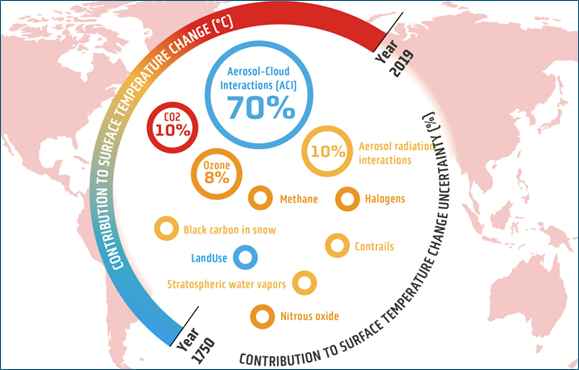
Aerosols, tiny particles originating from natural sources such as dust and sea spray as well as from human-made emissions, influence climate in two fundamental ways. They directly scatter or absorb solar radiation, and indirectly affect cloud droplet number, cloud reflectivity, lifetime and radiative behaviour.
The magnitude and variability of these processes remain insufficiently constrained in climate models, contributing significantly to uncertainty in projection. Without improved understanding of how aerosols modulate cloud microphysics and radiative forcing, policymakers and planners face limitations in anticipating climate trends and extreme events on timescales relevant for adaptation and investment decisions.
A coordinated European response
ESA and EC leadership have recognised this as a strategic scientific gap that must be addressed collaboratively under Europe’s Earth System Science Initiative, requiring closer coordination between observation capabilities, advanced modelling and research communities.
More than 220 researchers from nearly 40 institutions are now collaborating under what is called the Aerosol-Cloud Alliance. The Alliance aims to amplify the impact of three complementary European projects: AIRSENSE, CERTAINTY, and CleanCloud. Together, they connect satellite observations, advanced data analysis and Earth system modelling into a coherent European effort.
Three complementary European projects
AIRSENSE (Aerosol and aerosol-cloud interaction from Remote SENSing Enhancement) is an ESA-funded project focused on improving aerosol and aerosol-cloud observational data from space and its utility for climate research.
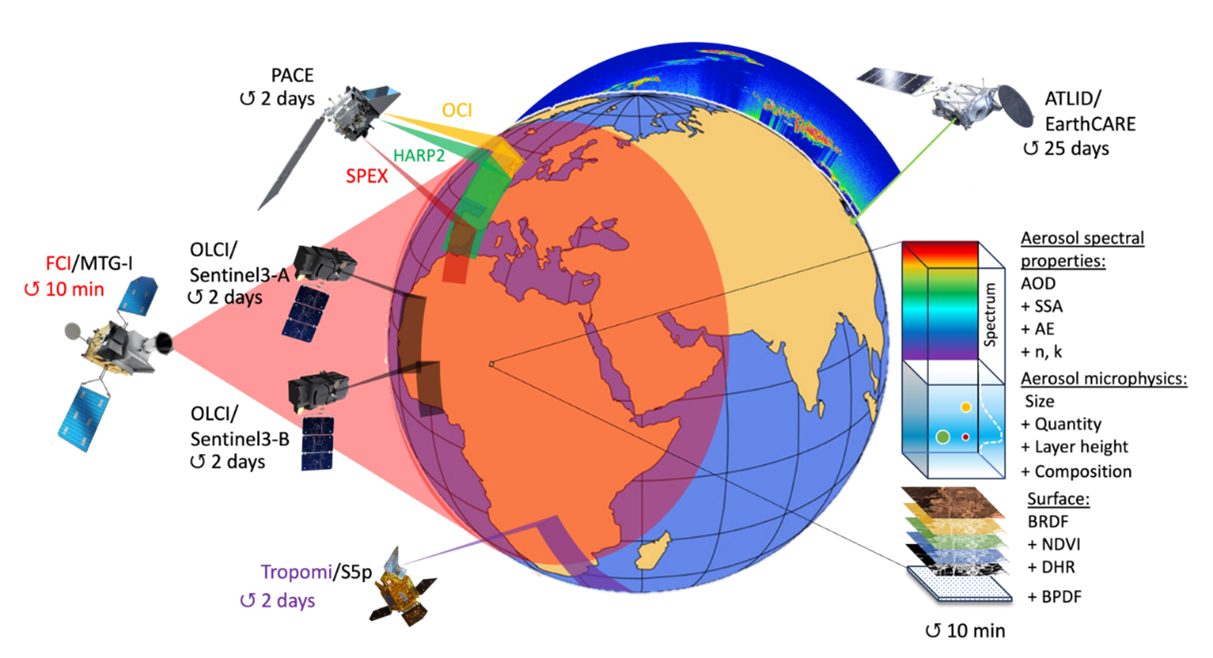
Its activities include developing synergistic retrieval algorithms that combine data from multiple satellite missions such as Sentinel-5P, EarthCARE and PRISMA; exploiting advanced instruments, including active lidar systems like EarthCARE’s ATLID, to derive aerosol vertical profiles and cloud-relevant microphysical parameters; and generating enhanced datasets designed for direct integration into modelling and assimilation systems.
By improving the quality and usability of satellite-derived aerosol and cloud products, AIRSENSE provides a critical observational backbone for downstream modelling efforts.
The Horizon Europe research project CERTAINTY (Cloud-aERosol inTeractions & their impActs IN The earth sYstem) improves understanding of aerosol, cloud and radiation interactions through integrated use of observations, machine learning and state-of-the-art Earth system and high-resolution models.
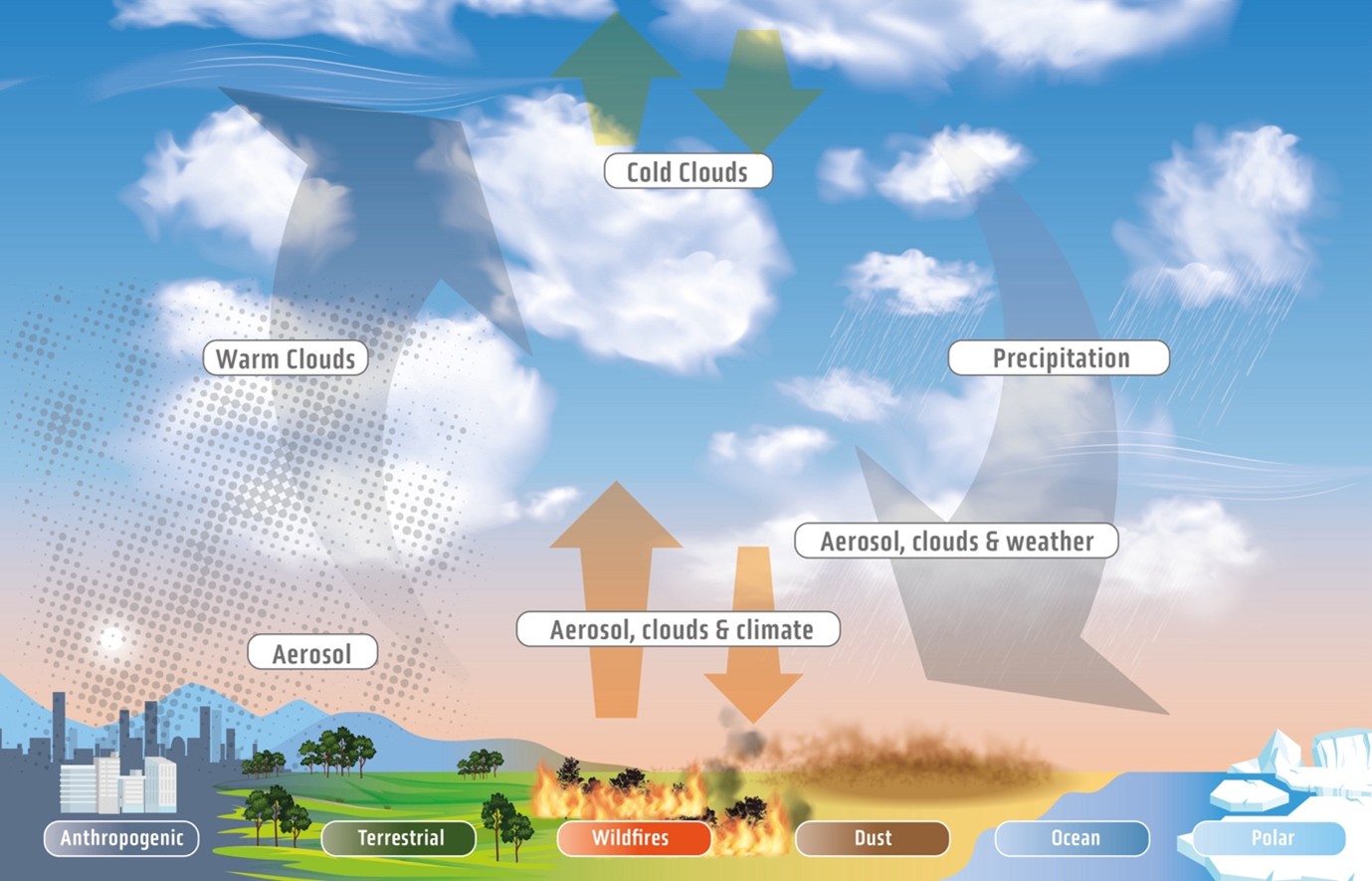
CERTAINTY accelerates the adoption and assimilation of next-generation satellite products, including those from EarthCARE and MetOp-SG, into numerical weather prediction and climate models. It actively bridges observational, remote sensing and modelling communities to refine process representation and enhance predictive skill for weather and climate extremes.
Its focus on cross-scale parameterisation strengthens Europe’s capacity to reduce structural uncertainty in climate projections.
CleanCloud (Clouds and climate transitioning to a post-fossil aerosol regime) is another Horizon Europe research initiative addressing aerosol–cloud interactions in the context of a transitioning climate characterised by sharp reductions in anthropogenic aerosol emissions.
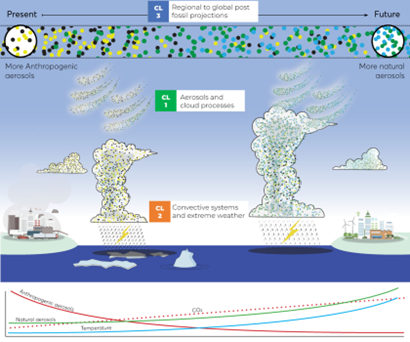
The project quantifies how aerosol–cloud interactions will evolve in a cleaner atmosphere within a “post-fossil” world, deploys targeted field campaigns in key climate-sensitive regions, and integrates satellite, airborne and ground-based observations with advanced modelling frameworks.
By explicitly addressing the transition toward a low-aerosol future, CleanCloud ensures that Europe’s climate intelligence remains robust under changing emission regimes.
Scientific and institutional synergies with political relevance and strategic value
The strength of the Aerosol-Cloud Alliance lies in how these projects reinforce one another. AIRSENSE provides high-quality, multi-mission satellite products that feed directly into CERTAINTY and CleanCloud modelling activities.
This enables better utilisation of unique new datasets from missions such as EarthCARE, which deliver unprecedented vertical profiling of clouds and aerosols and early validation and assimilation of satellite-derived cloud microphysical properties into predictive modelling frameworks.
More details about research outcomes will be presented during joint sessions to take place at the upcoming EGU26 General Assembly in Vienna, next 3-8 May.
The scientific collaboration has already delivered concrete outputs such as joint publications and a joint policy brief.
The latter highlights to EO policymakers direct and practical implications of existing uncertainty around aerosol–cloud interactions as well as opportunities for progress and policy recommendations.
From science to decision-making
Coordinated action across ESA and EC initiatives ensures that investments in space infrastructure, research funding and climate services are translated into actionable, policy-relevant knowledge for decision-making.
From a management perspective, the Aerosol-Cloud Alliance exemplifies best practice in cross-institutional integration:
- Joint participation in cluster workshops and science-policy forums aligns priorities, avoiding duplication and reinforcing mutual goals.
- ESA’s satellite data capabilities and the EC’s research funding create synergies that increase the return on European investments in climate science.
Regular meetings between project teams, DG-RTD, ESA-ESRIN, and agencies such as CINEA reinforce alignment between operational Earth observations and research requirements.
From fragmentation to integration
The challenge of aerosol-cloud interactions, once seen as a disjointed research frontier, is now a focal point of coordinated European action. Through AIRSENSE, CERTAINTY, and CleanCloud, Europe is aligning observational innovation, modelling excellence and strategic research funding to address a critical knowledge gap that directly affects near-term climate predictions.
As climate risks intensify over the coming decades, understanding how microscopic particles shape vast cloud systems may prove essential for turning climate uncertainty into informed action and for ensuring that Europe remains at the forefront of Earth system science.
The Aerosol-Cloud Alliance is one example of a growing portfolio of coordinated EC-ESA collaborations tackling complex scientific challenges across the Earth system. Stay tuned for future articles highlighting additional alliances.