
For decades, Synthetic Aperture Radar (SAR) satellites quietly transformed how we observe Earth. From early defence missions to flagship Earth-observation platforms like ERS, Envisat, and Sentinel-1, SAR has been valued for its ability to see through clouds, darkness, and adverse weather.
Today, a new chapter has begun.
Small satellites, flying in coordinated constellations and equipped with agile, high-gain antennas, have fundamentally changed what SAR can do. They are no longer just imaging the Earth, they are capturing motion itself. Subtle vibrations. Engine rhythms. The hidden dynamics of vehicles, infrastructure, and ships.
Those motions can be measured from a single SAR image.
A new opportunity: micro-motion from space
Traditional SAR images freeze the world in time. But when a satellite observes a target for several seconds, something remarkable happens: tiny movements leave measurable signatures in the radar phase.
These micro-motions (engine vibrations, structural oscillations, mechanical rotations) carry rich information. If extracted correctly, they can reveal what a target is doing, not just where it is.
Researchers have explored this idea before, first using airborne SAR and later spaceborne systems. Existing approaches demonstrated promise but came with trade-offs:
- Heavy computational demands
- Sensitivity to parameter selection
- Dependence on low-level radar data that are often inaccessible
The question remained: can micro-motion be reliably extracted using standard SAR products? This is one of the questions explored within various ESA-funded activities, in particular the SAR micro-doppler processing project.
The core idea: sub-aperture phase analysis
Instead of relying on image intensity changes or raw radar data, researchers explored a method which operates directly on Single Look Complex (SLC) SAR images, products already widely available.
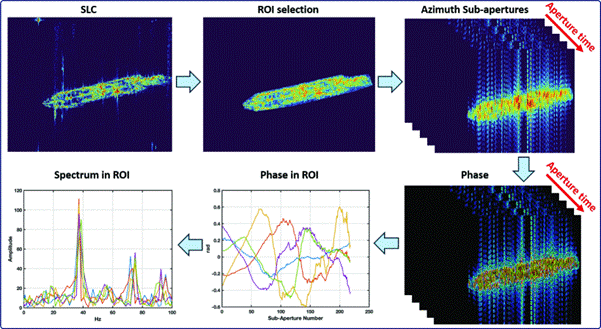
The process unfolds in three key steps:
- Focus on the target: a region of interest (ROI) is extracted around the object, such as a vehicle or vessel.
- Restore time resolution: the SAR aperture is divided into overlapping sub-apertures, each representing a short time window during the satellite pass.
- Measure phase: for each pixel in the ROI, the radar phase is tracked across sub-apertures. Periodic micro-motions appear as oscillations in phase, which can be analyzed spectrally.
In essence, the radar image becomes a time series, and the target reveals its internal motion.
Case study 1: an idling van in Glasgow
The first experiment focused on a Volkswagen Transporter van parked in Glasgow.
During the satellite pass:
- The van was idling at approximately 870 RPM
- A triaxial accelerometer was mounted on the bonnet to provide ground truth
From orbit, the SAR data told the same story.
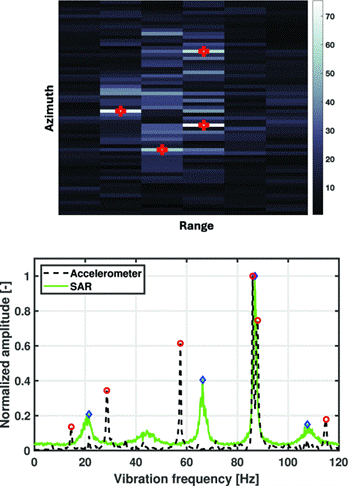
The phase analysis revealed a clear spectral peak at 87 Hz, matching the dominant vibration measured by the accelerometer. While weaker harmonics were present in the ground data, only the strongest component propagated clearly through the vehicle structure and into the radar signal.
Case study 2: a ship in Galway Bay
The second scenario moved offshore.
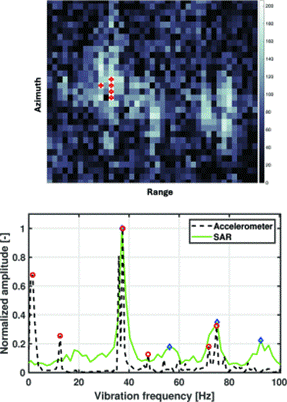
A cooperative vessel sailed through Galway Bay at low speed, powered by twin synchronized diesel engines. Eight accelerometers distributed across the ship recorded vibrations during the SAR acquisition.
Despite the short observation time and dynamic maritime environment, the results were striking:
- A dominant spectral peak at 36 Hz, precisely matching the engine firing rate
- A secondary vibration component associated with ship structure
Lower-frequency motions caused by waves were present in the accelerometer data but too slow to be captured within the brief SAR dwell time.
In short
These results demonstrate that micro-motion can be extracted from a single SAR pass using standard SLC data, and both land and maritime targets can be characterized reliably.
This processing method enriches the pool of microdoppler techniques described in the story published last May while also opening the door to additional advanced applications.
SAR is no longer just imaging the Earth. It is listening to it.
Featured video: ICEYE acquisition (25th September 2024 at 11:28 UTC ) over Ireland’s west coast, showing the Galway Girl vessel (bright spot in the yellow circle). The signal extracted from processing the SAR image was converted into the audible range (sonified) to make hearing the detected vibrations possible. The resulting sound reflects the same mechanical rhythm captured by an hydrophone recording real sound in the water. Credit: University of Strathclyde, Glasgow