
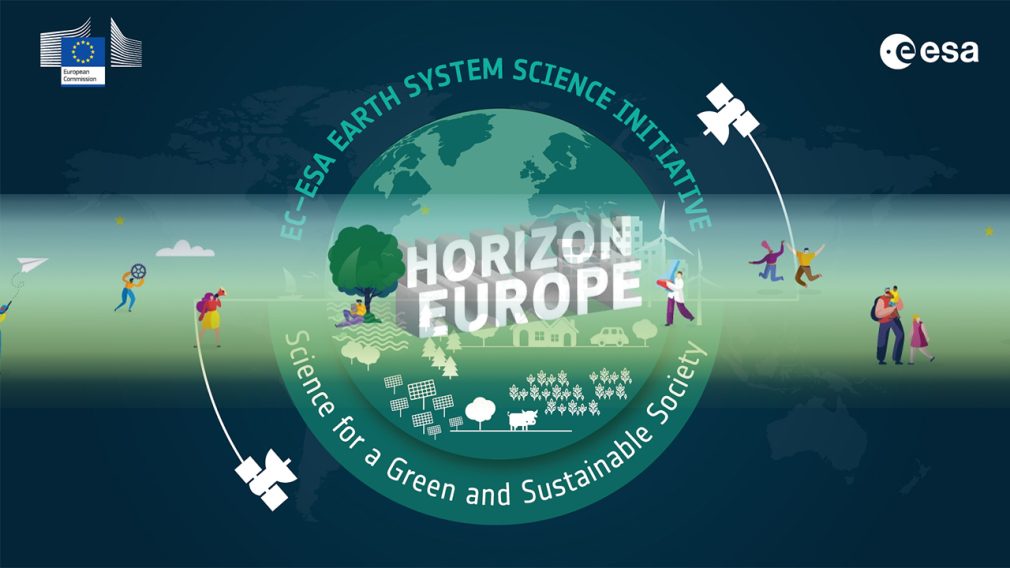
The European Commission has launched the Horizon Europe 2026–2027 Work Programme, opening for a new set of calls that reinforce Europe’s ambition to lead the global green transition through science, innovation and strategic partnerships.
A key feature of the new work programme is the strengthened coordination between EC and ESA across Clusters 5 (Climate, Energy and Mobility) and Cluster 6 (Food, Bioeconomy, Natural Resources, Agriculture and Environment). Projects funded under the 2026–2027 calls will be invited to engage with the EC-ESA Earth System Science Initiative (ESSI) and explore pathways for scientific, technical, and strategic cooperation.
The Earth System Science Initiative was launched in 2020 to serve as a community-building framework bringing together Horizon Europe–funded projects and ESA FutureEO activities across multiple Earth system science flagships to better understand and prepare for the triple-planetary crisis leveraging EO data and systems. Since its start in 2020 ESSI has brought together over 70 projects, collocating over ½ billion Euros across EC and ESA activities.
Currently open Horizon 2026 Call for Proposals
The currently open call HORIZON-CL5-2026-08-Two-Stage-D1-06, with deadlines 15 April 2026 (stage 1) and 8 October 2026 (stage 2), is titled Closing knowledge gaps on Earth system science in support of global and regional assessments and climate policy.
It aims to fund collaborative research and innovation actions that seek to narrow the knowledge gaps in the realm of Earth system science (understood here as the scope of Working Group I of the IPCC), offering flexibility for applicants to define the specific research areas targeted. Proposals indicating use of satellite remote sensing data and derived products are encouraged to collaborate with projects selected under ESA’s FutureEO programme and the EC-ESA Earth System Science Initiative (ESSI) to facilitate access to and uptake of satellite data products and related tools or methodologies. They should dedicate resources for collaborative actions.
Calls in the pipeline for 2026
A few more calls are already planned to open in the coming months.
In less than one week, on 12 February 2026, the HORIZON-CL6-2026-03-GOVERNANCE-01-two-stage, titled Open topic: Develop Earth Intelligence solutions using environmental observations and state-of-the-art AI for sustainable competitiveness and policy making is opening. This aims at supporting the development and demonstration of “Earth Intelligence” systems that integrate environmental observations and cutting-edge AI to generate data-driven tools and insights, strengthening evidence-based decision-making for sustainable competitiveness and informing national, EU-level and international environmental policy formulation and implementation.
On 17 April 2026 the HORIZON-CL6-2026-01-BIODIV-05 call will be opened. This is about Advancing integrated scenarios and prediction models for informing transition to a nature positive society and its scope is to advance integrated scenarios and predictive modelling to inform and support the transition toward a nature-positive society, enhancing tools and foresight for biodiversity conservation, ecosystem management, and policy-relevant decision-making.
Two more calls will be opening this year on 17 November 2026:
HORIZON-CL5-2027-01-D1-07, Advancing understanding, modelling and prediction of extreme events in a changing climate, will focus on advancing scientific understanding, modelling and prediction of extreme climate-related events in a changing climate to better support decision-making, risk assessment and adaptation strategies at multiple scales.
HORIZON-CL5-2027-01-D1-12, Better understanding and attribution of land and ocean carbon sources and sinks, will aim to improve scientific understanding and attribution of land and ocean carbon sources and sinks, including their drivers and dynamics under changing climate and mitigation scenarios, to reduce uncertainties in carbon budgets and support better climate policy and reporting.
Planned 2027 Calls
For next year, all tentatively opening on 20 April 2027, several topics are in the pipeline:
HORIZON-CL6-2027-01-BIODIV-01, Integrating Remote Sensing and in-situ observations of Biodiversity, towards a fully interoperable observation and data framework, will focus on integration of remote sensing and in-situ biodiversity observations into a fully interoperable observation and data framework to strengthen biodiversity monitoring, improve ecosystem assessments, and support policy-relevant decision-making on nature protection and restoration.
HORIZON-CL6-2027-01-ZEROPOLLUTION-02, Developing effective air quality planning strategies through innovative multi-scale modelling will support research and innovation for developing effective, multi-scale air quality planning strategies using advanced modelling tools and approaches to better inform policy implementation, improve governance processes, reduce population exposure to air pollution, and provide authorities with enhanced evidence and tools for air quality management.
HORIZON-CL6-2027-02-CLIMATE-01, Governance, sustainable development and international politics of a future ice-free Arctic, will support research on the governance, sustainable development and international politics of a future ice-free Arctic, advancing understanding of political, environmental and societal dimensions to inform policy responses to rapid climate-driven changes in the Arctic region.
HORIZON-CL6-2027-02-CLIMATE-04, Unlocking a safe operating space for Antarctica and the Southern Ocean, will fund research and innovation actions that advance multidisciplinary scientific understanding of the Southern Ocean, the Antarctic cryosphere and their coupled ecosystem and climate system dynamics to define a safe operating space that informs climate risk assessment, long-term projections and policy responses for global and regional environmental sustainability.
More information
Official guidance for Horizon Europe calls is available at this page. More detailed topic descriptions can be found on the Funding & Tenders Portal, and in the Info Days recordings:
The topics are part of the coordination initiative between ESA and EC on Earth System Science under various Flagships. Successful consortia will be asked to coordinate with projects to be selected under ESA’s FutureEO programme. To this end, proposals shall foresee sufficient means for effective coordination.
Stay tuned for the opening of the calls and for more information on the upcoming FutureEO calls related to the EC-ESA Earth System Science Initiative (ESSI) on this webpage.