

The Arctic is warming rapidly, with thawing permafrost releasing carbon that has been locked in frozen ground for thousands of years. While there is high confidence that permafrost thaw will lead to increased carbon release, important questions remain about when these emissions will occur, their magnitude, and the relative contribution of carbon dioxide (CO₂) and methane (CH₄).
Earth observation can play a key role in addressing these uncertainties. Satellites provide measurements across the vast and remote Arctic, offering an essential complement to observations made on the ground and through modelling. Yet exploiting the full potential of satellite observations requires different scientific communities, measurement strategies and modelling approaches to work together.
This was the focus of AMPAC-Net, a network established to support the Arctic Methane and Permafrost Challenge (AMPAC), a transatlantic initiative bringing together activities from Europe and North America led by NASA and ESA. AMPAC-Net has worked to strengthen collaboration between European, American and Canadian researchers and to connect communities with complementary expertise.
Connecting observations, models and future missions
AMPAC brings together three complementary areas of work: observations, reconciling observation strategies and modelling, and future missions. AMPAC-Net has supported these activities by informing research groups about the initiative, connecting researchers and identifying opportunities for collaboration.
Community engagement has been a central part of the network. Four workshops were held between October 2022 and May 2025, bringing researchers together in hybrid and in-person meetings in Italy, Finland and Sweden. These meetings provided opportunities to agree common strategies, compare approaches and develop activities across the different AMPAC working groups. They were: side meeting to ESA Carbon from Space conference October 25th-28th 2022 (ESRIN, Hybrid), in person meeting hosted by FMI in Helsinki, 17th – 19th of January 2023, in person meeting in Tovetorp (Sweden) in March 19th -21st 2024 and a further meeting at FMI, Helsinki 26th -28th May 2025.
One practical outcome has been the creation of a methane-focused data catalogue as a sub-catalogue of the Arctic Permafrost Geospatial Centre. Initially containing 83 datasets organised into 11 product groups, the catalogue provides a shared entry point to data relevant to the AMPAC community.
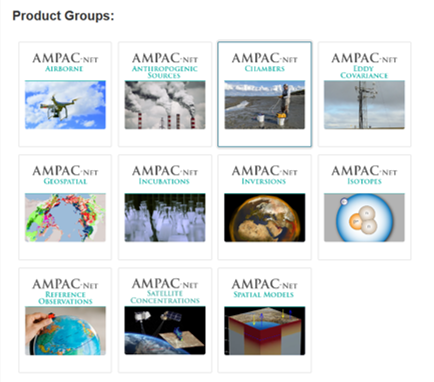
The exercise also highlighted an important challenge: datasets associated with spatial models and inversions remain relatively difficult to access compared with the number of datasets identified as relevant to AMPAC. This points to the continued need for researchers to make data products openly available through repositories that provide persistent identifiers such as DOIs.
Comparing ways of measuring methane
AMPAC-Net has also supported benchmarking activities designed to compare different approaches to understanding Arctic methane. Two key topics were wetland representation and atmospheric methane concentrations.
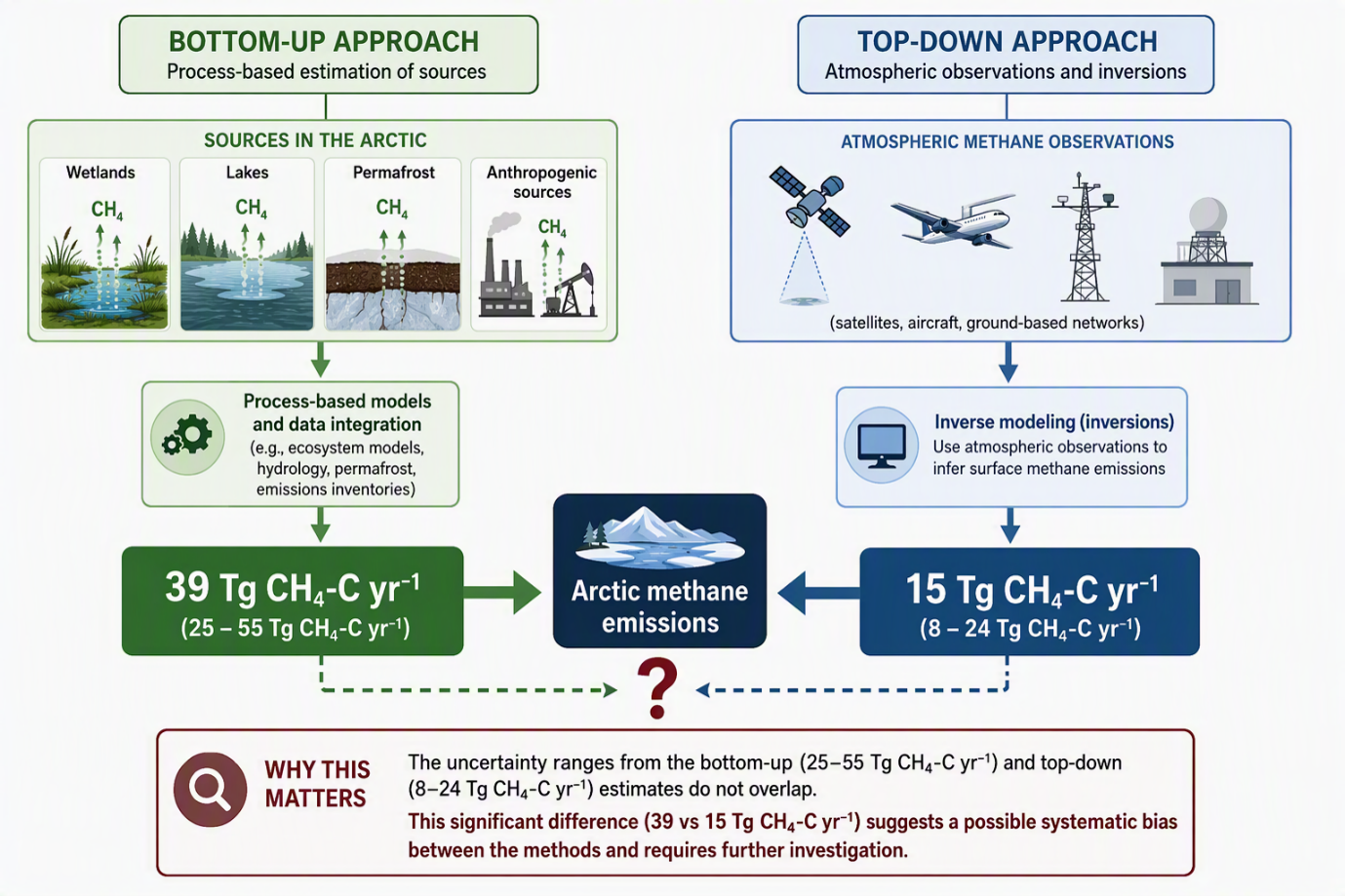
A particular focus has been the comparison of bottom-up and top-down approaches to estimating methane emissions. Bottom-up estimates build from processes and emission sources, while top-down approaches use atmospheric observations and inverse modelling to infer emissions.
The latest synthesis integrated 15 atmospheric inversions. Both approaches identified Arctic methane sources, but they produced substantially different estimates: around 39 Tg CH₄-C per year from the integrated bottom-up budget, compared with 15 Tg CH₄-C per year from top-down atmospheric inversions. Their uncertainty ranges did not overlap, pointing to a systematic difference between the approaches that requires further investigation.
Satellite observations are an important part of this effort. AMPAC-Net has investigated, among other topics, the potential of TROPOMI-based inversions to contribute to understanding Arctic methane emissions.
From collaboration to new knowledge
The network has worked closely with a wider group of related initiatives, including ESA MethaneCamp, ESA CCI+ Permafrost, EU HORIZON ILLUQ and ERC Q-Arctic. By March 2026, this collaboration had contributed to 25 manuscripts published or accepted for publication, including research addressing methane emissions from lakes and wetlands, observation scales for wetlands, and the potential contribution of future satellite missions to AMPAC’s scientific goals.
These activities also contributed to the RECCAP-2 permafrost component, supporting broader assessments of the carbon cycle and its implications for climate change.